
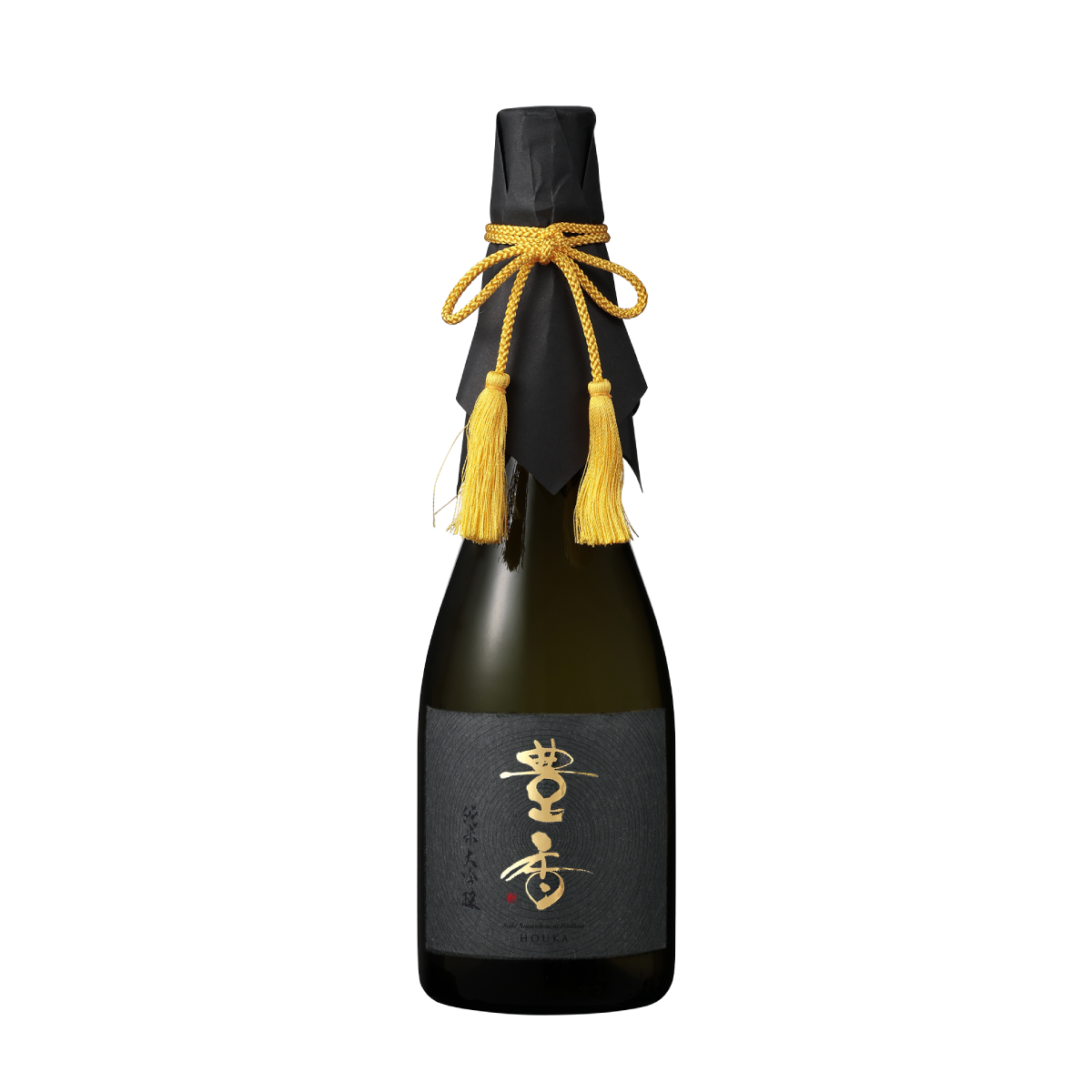
Houka Vintage 2025 Junmai Daiginjo - 720ml
Houka Vintage 2025 Junmai Daiginjo is a limited-edition sake with only around 428 bottles released, presented in an elegantly designed 720ml bottle. Brewed from three sake rice varieties grown in Nagano Prefecture—Kinmon Nishiki, Yamada Nishiki and Takane Nishiki—it carries the signature of the brewery’s pasteurisation method, which preserves a subtle gassy character. The sake is then aged for about six months at low temperature, developing into a refined and distinguished Junmai Daiginjo.
Toshimaya Brewery in Nagano has been producing artisanal sake since 1891 on the shores of the mystical Suwa Lake. With an annual production of just 1700 koku, it is a true craft brewery led by Toji Komatsu Yukio and guided by the vision of the young president. The brewery uses water sourced from Mount Hachi Buse, carefully balancing minerals such as magnesium and potassium to suit the yeast starter. The rice is cultivated locally by contracted farmers, creating a strong bond between the growers and the brewer, a connection proudly celebrated in the tasting room where the farmers’ portraits are displayed. Alongside classic rice types like Miyama Nishiki, Yamada Nishiki and Kinmon Nishiki, local varieties including Takane Nishiki, Shirakaba Nishiki and Hitogokochi are also used. The brewery is further distinguished by a private collection of Samurai armour housed in a hidden museum and has earned repeated gold medals at the International Wine Challenge.
| Prefecture: | Nagano |
|---|---|
| Alcohol: | 17.0% |
| Classification: | Junmai Daiginjo |
| Style: | Exclusieve import, Limited edition |
| Content: | 720ml |
| Rice polishing ratio: | 39% |
| Rice type: | Kinmon-nishiki, Takane-nishiki, Yamada-nishiki |
| How to serve: | Reishu 冷酒 (refrigerated) |
| Giftbox: | Wooden box |
| Importer: | Sake.nl - own exclusive import |
Product information "Houka Vintage 2025 Junmai Daiginjo - 720ml"
Houka Vintage 2025 Junmai Daiginjo is a limited-edition sake with only around 428 bottles released, presented in an elegantly designed 720ml bottle. Brewed from three sake rice varieties grown in Nagano Prefecture—Kinmon Nishiki, Yamada Nishiki and Takane Nishiki—it carries the signature of the brewery’s pasteurisation method, which preserves a subtle gassy character. The sake is then aged for about six months at low temperature, developing into a refined and distinguished Junmai Daiginjo.
Toshimaya Brewery in Nagano has been producing artisanal sake since 1891 on the shores of the mystical Suwa Lake. With an annual production of just 1700 koku, it is a true craft brewery led by Toji Komatsu Yukio and guided by the vision of the young president. The brewery uses water sourced from Mount Hachi Buse, carefully balancing minerals such as magnesium and potassium to suit the yeast starter. The rice is cultivated locally by contracted farmers, creating a strong bond between the growers and the brewer, a connection proudly celebrated in the tasting room where the farmers’ portraits are displayed. Alongside classic rice types like Miyama Nishiki, Yamada Nishiki and Kinmon Nishiki, local varieties including Takane Nishiki, Shirakaba Nishiki and Hitogokochi are also used. The brewery is further distinguished by a private collection of Samurai armour housed in a hidden museum and has earned repeated gold medals at the International Wine Challenge.
| Prefecture: | Nagano |
|---|---|
| Alcohol: | 17.0% |
| Classification: | Junmai Daiginjo |
| Style: | Exclusieve import, Limited edition |
| Content: | 720ml |
| Rice polishing ratio: | 39% |
| Rice type: | Kinmon-nishiki, Takane-nishiki, Yamada-nishiki |
| How to serve: | Reishu 冷酒 (refrigerated) |
| Giftbox: | Wooden box |
| Importer: | Sake.nl - own exclusive import |
Toshimaya Brewery is one of the many pearls that Nagano has to offer. The brewery, founded in 1891, is located on the mystical Suwa Lake and with only 1700 Koku of traditionally made sake, it is a typical artisan brewery. The sake is brewed under the leadership of Toji Komatsu Yukio who follows the course of the current young president.
The water from Mount Hachi Buse used for sake brewing is fully in line with the brewing techniques in which the amount of magnesium, potassium in the water and the influence on the yeast starter have been carefully considered. The rice that is used is grown locally by contract rice farmers, so there is an enormous connection between the suppliers of the rice and the brewer. Depending on the sake that is brewed, the perfect rice that fits with this has been looked at. The pride in the suppliers is also reflected in the reception and tasting room where almost all photos rice farmers are on display.
In addition to the well-known sake rice varieties such as Miyama-nishiki, Yamada-nishiki, Kinmon-nishiki, the use of local varieties such as Takene-nishiki, Shirakaba-nishiki and Hitogokochi is used.
A unique brewery with a rare collection of Samurai Armor in a hidden private museum. The brewery wins gold medals at the International Wine Challenge almost every year.
How we pack your order
Safe & careful packaging
- Every sake bottle is individually wrapped and secured with shock-absorbing materials.
- Reinforced dividers keep bottles from touching.
- Box sizes: 1, 3, 6 and 12 bottles—combined so everything fits snugly.
- Premium/limited editions receive extra protection (neck/base guards + added cushioning).
Temperature control
- To preserve flavour and aroma we use insulated packaging and, when needed, cold packs.
- Summer/Winter protocol: during heat or cold snaps we adjust packaging and dispatch day.
- Moisture-resistant inner layer used where appropriate to prevent condensation.
Reliable delivery
- Shipped with trusted carriers. You receive track & trace and email updates.
- Timed delivery or pickup point available (carrier dependent).
- Missed delivery? We’ll attempt again automatically or route to a nearby pickup point.
Sustainable packaging
- FSC-certified cartons and 100% recyclable void fill.
- Less plastic: paper tape and reuse of clean supplier boxes where possible.
- Compact packing to avoid shipping air and reduce CO₂.